Hi, I’m Crafty Olive.
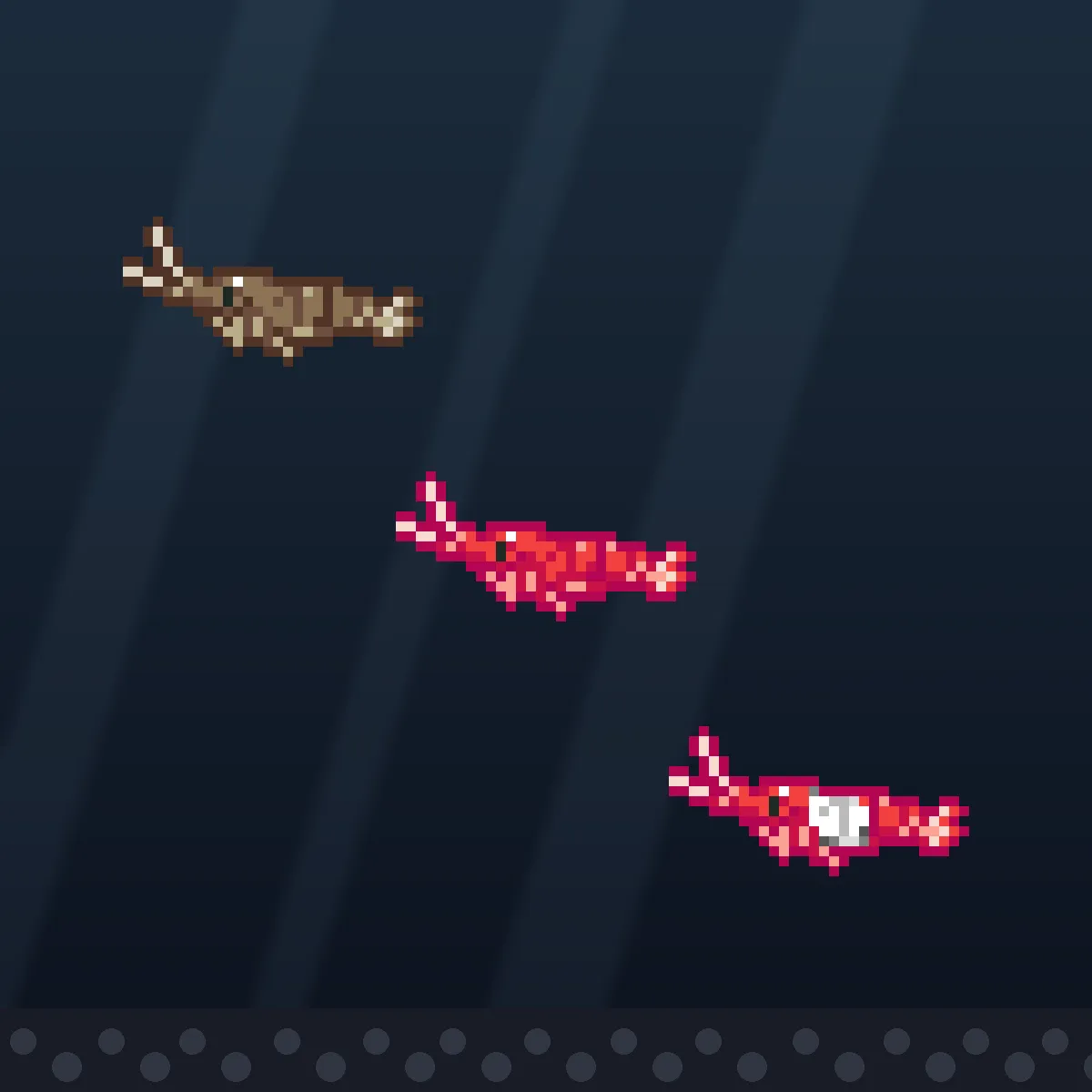
I modeled my game, Shrimprium, on cherry shrimp. As the name suggests, the first cherry shrimp were red. But that red isn’t a colour nature made. The wild shrimp that cherry shrimp come from are brown.12
The story of shrimp in aquariums starts with a different shrimp. In the early 1980s, Takashi Amano, the Japanese aquarist behind the “Nature Aquarium” style of planted tanks arranged like landscapes, was looking for a shrimp that would eat algae. He found the Yamato shrimp and ordered several thousand for his tanks. The species later came to be known as the Amano shrimp, after him.34 From then on, shrimp had a place in aquariums as cleaners that kept the algae down.
Cherry shrimp are Neocaridina davidi, a species from slow streams and ponds in East Asia, including Taiwan, southern China, Vietnam and Korea. The French zoologist Bouvier first described it in 1904,15 and scientists still debate how it should be classified.6 In the wild, a brown or translucent body helps it stay out of sight of predators.
The red was made by people. In the 1990s, breeders in Taiwan, Japan and elsewhere in Asia picked out the slightly redder shrimp and bred them, generation after generation, until they had cherry shrimp. Accounts differ on who did it first and when.78 From the late 1990s, cherry shrimp spread to aquariums around the world.89
After that, the colours took off. Even the reds were split into grades by intensity, such as cherry, sakura, fire red and painted red,10 and yellow, orange, blue, green and black lines followed.25 Around 2010, the “Rili” pattern, in which parts of the body are clear, appeared in Taiwan.1112 They all look different, but they are all one species.
This colourful history has a shadow. Cherry shrimp released from aquariums have settled in the wild in the United States, Japan, Israel and Europe,13 and in Poland a population turned up in canals warmed by power plant discharge water.1 Never release your shrimp into the wild.
Footnotes
-
University of Florida IFAS Extension, “Cherry Shrimp Neocaridina davidi (Bouvier 1904)”. Native range, wild colouration, naming history, Polish canal population. ↩ ↩2 ↩3
-
“All Shades of Shrimp: Preferences of Colour Morphs of a Freshwater Shrimp Neocaridina davidi (Decapoda, Atyidae) for Substrata of Different Colouration”. Wild colouration and colour morphs. ↩ ↩2
-
Wikipedia, “Takashi Amano”. Yamato shrimp for algae control in the 1980s; origin of the name. ↩
-
Practical Fishkeeping, “Amano shrimp gets new name”. The order of several thousand shrimp; reclassification from Caridina japonica to C. multidentata. ↩
-
U.S. Geological Survey, “Cherry shrimp (Neocaridina davidi) – Species Profile”. Native range and colour morphs. ↩ ↩2
-
“Integrative Taxonomy Reveals New Insights into the Species Validity of the Neocaridina davidi–N. denticulata–N. heteropoda Complex and Mitogenomic Phylogeny of Caridean Shrimps”, Current Issues in Molecular Biology (2024). The classification debate. ↩
-
Mad Shrimp, “The Neocaridina Story: From Cherry Shrimp to Now”. Competing accounts of the first red line. ↩
-
Earth.com, “Red cherry shrimp”. Selective breeding in Asia; worldwide popularity from the 1990s. ↩ ↩2
-
The Shrimp Farm, “Red Cherry Shrimp Care”. Arrival in the United States in the late 1990s. ↩
-
Shrimp and Snail Breeder, “Red Cherry Shrimp Grading”. Grades of red. ↩
-
Aquarium Glaser, “Neocaridina heteropoda RILI”. Introduced as a new pattern from Taiwan. ↩
-
Flip Aquatics, “Species Spotlight: Red Rili Shrimp”. Developed around 2010. ↩
-
Boletim do Instituto de Pesca, report on Neocaridina davidi as an introduced species. Invasive records in the United States, Japan, Israel and Europe. ↩